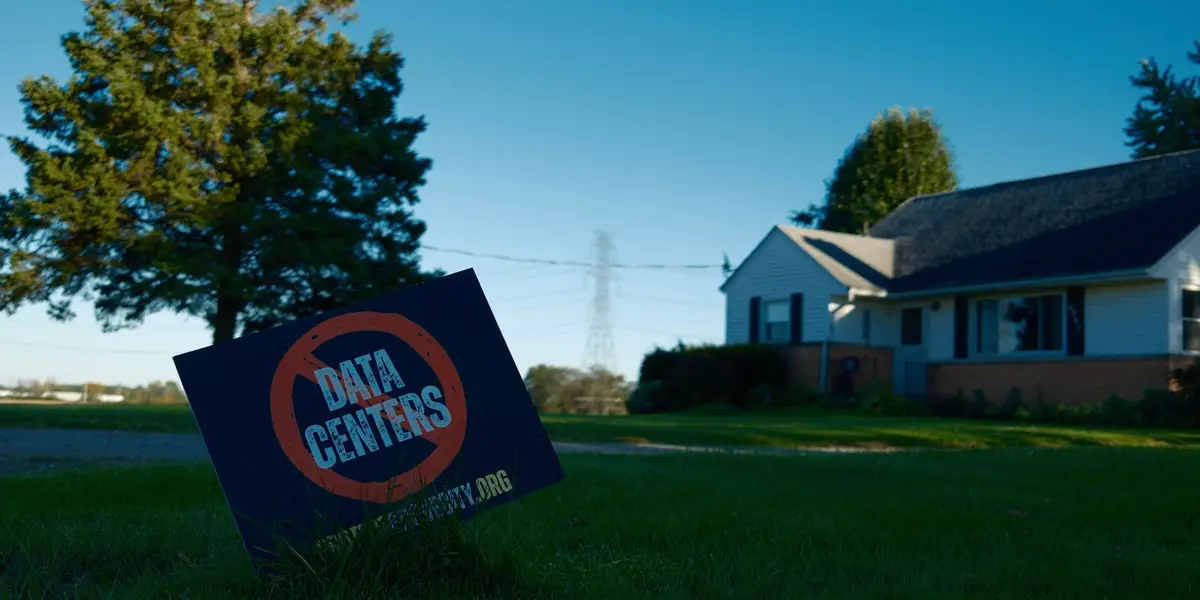
Some 60 feet separate Patty Spillman’s living room from the fields where six enormous, humming halls could soon be built.
Read more The annoying scam that may be hiding in your work calendar
The 63-year-old woman sits in a wide leather armchair, gazing out of the window across the cornfields that could soon make way for an AI data center. “This is our life here, it’s all we know,” she says.
It is quiet here in rural Ohio, in the American Midwest. Only occasionally is the gentle sound of the wind chimes on Spillman’s porch interrupted by a pickup truck speeding far too fast toward the city of Columbus, half an hour away.
Her family has run a farm near Grove City for seven generations. One day, her grandson is supposed to take it over. “He’s 12 years old and has just learned to drive our big tractor,” she says, her eyes filling with tears. “He was so proud.”
A real estate developer offered her $1.5 million to give up that dream to make room for the data center. It was a lot of money for part of the farm, but Spillman rejected the offer immediately. “It’s our land. It’s not for sale,” she says.
“Look, the beans are growing in the field right now,” Spillman says, pointing out of the window. Her neighbors, however, accepted the offer and sold their farms.
Spillman, from Grove City, voted for President Donald Trump three times. A businessman who would shake up politics in bureaucratic Washington appealed to her. Now that he is so vehemently backing data centers, she is deeply disappointed. “Nobody. I’m not voting for anybody,” she says when asked about the coming midterm elections.
Republican Sen. Jon Husted actively courted data center developers when he was lieutenant governor, and only 38% of Ohio voters view data centers positively, according to a New York Times poll. A bill he introduced in the Senate to protect citizens from rising energy costs has done little to change that.
In 18 communities across the state, including Grove City, voters will decide on measures related to such projects on Election Day in early November. There, residents want to ensure that citizens will have a say in major future projects. Concerns about data centers are widespread, and so is the anger.
For Republicans, this mood is dangerous. Ohio is one of the battlegrounds in the fight for control of the Senate. Democrats need to win a seat. For Democratic challenger Sherrod Brown, this is an opportunity to turn public anger over data centers into political capital. Yet the polls show Democrats and Republicans neck and neck.
Republicans are fighting for every vote. Just over an hour west of Spillman’s farm, in Vandalia, a suburb of Dayton, the smell of hot dogs and soft drinks fills the air on a Saturday afternoon. Enterprising vendors are selling MAGA merchandise to supporters waiting in line.
Catherine is standing in the long queue outside the high school where Trump is due to appear that evening. She talks about data centers much like Spillman does. “They bring hardly any jobs, pollute our water, and make noise,” she says.
The president will later claim the opposite at his rally. “We need them,” he tells his fans. It is one of the rare moments when the applause is merely polite. Catherine does not clap. Is Trump taking the wrong position here? “Yes,” she replies, short and to the point.
Voters like Catherine, in Republican strongholds such as Vandalia, are precisely the people Trump needs most. His approval ratings are at rock bottom, and Ohio reflects that trend.
According to The New York Times, only 38% of people in the state say he is doing a good job. Some 60% disapprove of his performance, three percentage points more than across the country as a whole. Republicans risk losing their majority in the House of Representatives. They are also fighting to retain their majority in the Senate.
Political strategists in Washington have a rule of thumb: The party of the incumbent president traditionally fares worse in midterm elections because the opposition can more easily mobilize dissatisfied voters. Trump wants to buck that trend with appearances like the one in Vandalia.
“Pretend that my name is on the ballot,” he tells his supporters. “Even if you hate Jon Husted, you’re going to go out, you’re gonna vote.”
“We’re going to win big, and we’re going to shove it up their ass,” he added.
Trump’s appearance shows that he can still campaign. He rails against the Democrats and gets the reaction he wants every time he makes a negative accusation: The packed hall cheers, applauds, and boos.
Read more How AI has raised the bar for Two Sigma internships and future hires
It is the warnings about the Democrats that also convince Catherine. “There’s a reason everybody says these are the most important midterms ever,” she says. On November 3, she will vote for Husted.
That does not work on Spillman. Democratic challenger Brown is trying to capitalize on her dissatisfaction with Trump and Husted. To that end, his campaign is organizing numerous smaller, more intimate events. Around 80 people have gathered on a Sunday afternoon in the banquet hall of a cultural center in Columbus, Ohio’s capital, at the invitation of Brown’s team.
The Democrat wants to reach the city’s Black voters that day and has brought together influential figures from the Black community. His speech is short, his voice hoarse. Brown spends much of it talking about Husted’s failings. He repeatedly calls him “the face of data centers.” He devotes the rest of his time to direct conversations with guests. He wants to come across as approachable and willing to listen to the community’s concerns.
Whether he succeeds is something the journalists present are not allowed to find out. The campaign does not permit them to speak to guests in the hall. Even in the car park, Brown’s press secretary interrupts every attempt to talk to people, without giving a reason. In The New York Times poll, Brown is only three percentage points ahead of Husted. The survey has a margin of error of five percentage points, meaning the two candidates are statistically tied.
Cyrus Richards is sitting on a bench in the adjoining park. He is not willing to be silenced. “It’s tough in America right now. People are fighting to survive economically,” he says in a rush.
Whether it is a car, school, or a holiday, people have to go into debt for everything because they do not have enough money. “Even dying costs money,” he says. Politicians are constantly telling him they want to fight for him, especially for him as a Black man. “But do they really mean it from the heart, or are they doing it to get my vote?”
Richards does not know whether he should vote for Brown. The issue of data centers does not stir much emotion in him. Brown’s campaign team invited him because he is influential. He coaches baseball and runs a theater club.
He pulls a flyer from a paper folder. “He spent the whole time talking negatively about his opponent,” Cyrus says of Brown. “Your tower doesn’t get any taller by knocking someone else’s down,” he says. “I want to know what you’re going to do for us.” Whom does he recommend that people in his community vote for? Cyrus shrugs. “Pray. I recommend praying. God will give us guidance,” he says.
For Spillman in Grove City, Brown is no alternative either, despite his vehement criticism of data centers. “He’s been in politics for so long, and everything has just kept getting worse and worse,” she says. Her frustration with politics has led her to activism.
Together with her friends Karen and Steve Church, she mobilized the town’s residents and forced the city council to impose a moratorium on the construction of the data center. They also quickly gathered the required number of signatures to place an amendment to the city charter on the November 3 ballot. The amendment would require a public vote on future industrial developments.
Mayor Richard Stage receives visitors at City Hall. He considers Spillman and her friends’ anger excessive. “Look at neighboring New Albany. There are 40 data centers there, and it’s one of the wealthiest communities,” he says. Stage wants Grove City to remain attractive to businesses in the future.
He has been in office for a long time. In the 1990s, he helped persuade Walmart to build a logistics center in the city. “Everybody was against it back then, too, but it made Grove City wealthy,” he says, looking pleased. If the citizens’ initiative succeeds, it would be “paralyzing” for the economy.
However, he does not want to adopt Trump’s claim that communities rejecting data centers will become “backward and poor.” Nor is he prepared to explicitly endorse the project next to Spillman’s farm, although he is generally positive about attracting such facilities. He considers concerns about their negative effects to be “hysteria.”
Spillman is sitting in her living room and bursts out laughing when she hears about this. The fact that politicians from the mayor to the president are working against her has left her feeling resigned. “I feel so lost,” she says.
On November 3, she will be watching just one result: the outcome of the ballot initiative. Whether the data center is built, “we’ll stay here and work our fields,” she says.
This story originally appeared in WELT and is courtesy of the Axel Springer Global Reporters Network, which harnesses the resources of the company’s newsrooms to publish ambitious scoops, investigations, interviews, opinion pieces, and analysis. It allows journalists — including those from POLITICO, Business Insider, WELT, BILD, Onet, and Fakt — to collaborate on major stories for an international audience of hundreds of millions across platforms.
About the Author