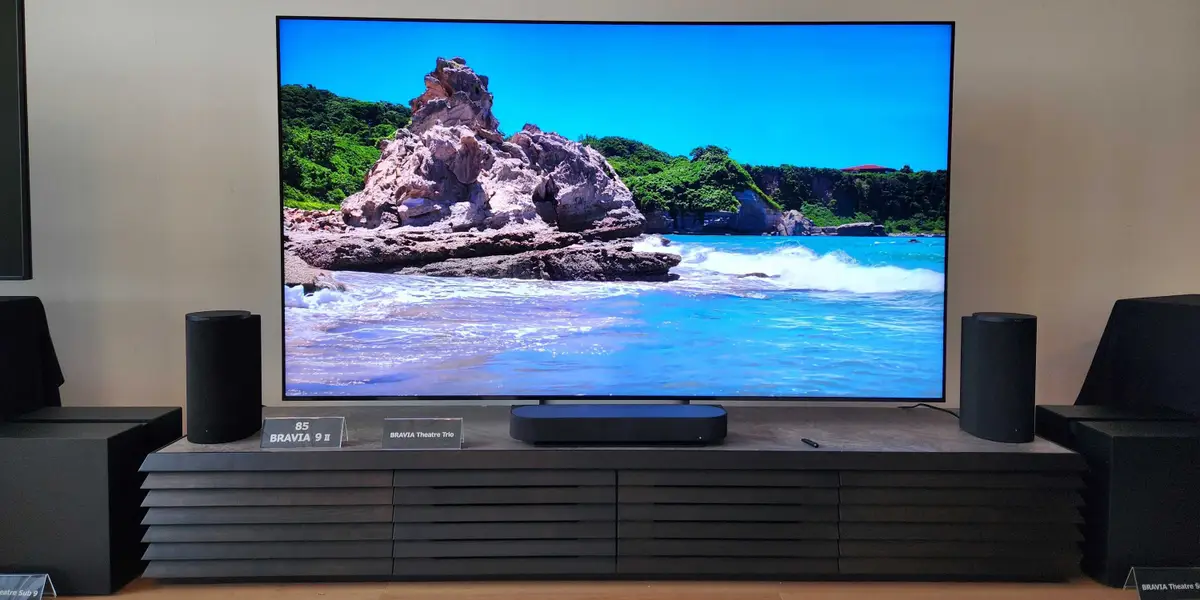
Following an initial tease in April, Sony has finally pulled back the curtain on its first lineup of True RGB TVs. The collection includes the Bravia 9 II and Bravia 7 II. Both models use the company’s new True RGB backlight system, which promises significant gains in color and brightness. I got a first look at the TVs during a visit to Sony’s Tokyo headquarters, and they don’t disappoint.
Read more Meta wants some of that sweet, sweet recurring revenue
The Bravia 9 II is the flagship model, and it could be the most impressive TV Sony has ever released. I was particularly struck by its accuracy when put head-to-head with a professional broadcast monitor, which filmmakers use to master Hollywood productions. The Bravia 7 II can’t quite reach those heights, but it uses the same color technology at a lower cost. Both models also boast premium designs, with unique transparent stands that almost make the TVs appear to be floating.
I’ve seen several RGB LED displays from brands like Samsung, LG, Hisense, and TCL, and though they’ve all been impressive in their own right, Sony’s Bravia 9 II delivers performance that’s a step above. This is the first time I’ve come across an LED display that might genuinely give the best OLED TVs a run for their money.
Here’s everything you need to know about the Bravia 9 II and 7 II, including a full breakdown of sizes, pricing, and first impressions.
Sony Bravia 9 II True RGB TV price and specs

The Bravia 9 II is Sony’s flagship True RGB TV. It delivers some of the best image quality we’ve seen on a consumer TV.
The Bravia 9 II just might be the best Sony TV ever made. I’ll need more time with the display to make a full verdict, but the initial demos I saw easily put this set in elite territory with the very best TVs on the market. And though I have technically seen slightly higher color coverage on other RGB LED TVs, none have delivered the overall balance of contrast, brightness, and color that I saw on the Bravia 9 II.
The TV features Sony’s new True RGB backlight system, which uses individual red, green, and blue LEDs to deliver a wider, purer, and brighter color range than other displays. You can learn more about the tech in my first-look breakdown of Sony True RGB.
I measured a peak brightness of 4,122 nits on a 10% HDR test pattern using the TV’s most accurate mode. That’s one of the highest measurements I’ve recorded on a TV. When it comes to color, I measured around 89% of the BT.2020 color space. I’ve seen slightly higher results on some Samsung and Hisense RGB LED sets, but the Bravia 9 II’s color is still impressive.
Of course, those raw numbers mean nothing if the TV doesn’t actually look good when watching content. Thankfully, the Bravia 9 II’s impressive specs translate to impressive picture quality. I tested the TV side-by-side with a professional Sony broadcast monitor and a Bravia 9 Mini LED TV (Sony’s previous flagship display). My initial time with the Bravia 9 II was limited, but I sampled various scenes from 4K Blu-ray discs like “Mad Max: Fury Road,” “Aquaman,” “Ex Machina,” and “1917.”
In every instance, the Bravia 9 II offered a richer, deeper, and noticeably more accurate picture than the Bravia 9. And that’s saying something, since the Bravia 9 remains one of the best Mini LED TVs available. The Bravia 9 II also came remarkably close to matching the image on the broadcast monitor, which is what many Hollywood filmmakers use to master their movies.
Lightning blasts in “Mad Max: Fury Road” popped from the screen with greater intensity than I’ve seen on most rival sets. The opening scene of “The Matrix” featured inky black levels without a hint of blooming (halos around bright objects). In comparison, colors looked a bit faded on the Bravia 9 Mini LED, and contrast control wasn’t as precise.
The Bravia 9 II also displayed wider viewing angles. In a test scene I use from “Ex Machina,” the Bravia 9’s image veered from red to orange from the side. The Bravia 9 II still lost some color intensity from an angle, but it maintained a red tone much better. This scene was also free from banding (blocky colors), which appears on many competing TVs. That said, blooming does still become more visible from an angle on the Bravia 9 II.
Read more Some users may be giving Google’s AI search the bird, and DuckDuckGo is benefiting
The Bravia 9 II’s design is also as premium as its image quality. The TV has one of the most effective anti-reflective screens I’ve seen, besting Samsung’s latest efforts. Sony calls this tech Immersive Black Screen Pro. I was able to see a Bravia 9 II with half of its screen using this tech, and the other half without. The difference was night and day.
The Immersive Black Screen Pro essentially eliminated reflections. It also preserved black levels better than what I’ve seen on Samsung’s anti-glare screens. To be clear, there is still some loss of contrast in a bright room, but it’s a better compromise than the competition.
A special note must also be made of the Bravia 9 II’s stand, which features a unique transparent design that uses optical refraction to make it appear as if there’s nothing behind the pedestal. But when you look at the TV from behind, you can see that there actually are cables hanging there. This is one of those small yet clever design touches that just makes you smile when you see it in person.
The Bravia 9 II is now available for preorder in 65 to 85 inches, with prices starting at $3,600. That’s not cheap, but it’s in line with what flagship sets from other brands cost. An extra-large 115-inch size will also be available later this fall. However, the 115-inch model features some design differences as it does not use the transparent stand or anti-reflective screen found on its smaller counterparts.
Again, I’ll need more time with the Bravia 9 II to make a full judgement, but what I saw left me instantly wanting more. There are areas where top OLEDs still have an edge, but the Bravia 9 II’s unique strengths could make it a better high-end TV for certain users. I’ll be getting more hands-on time with the Bravia 9 II soon, so stay tuned for my full review.
Sony Bravia 7 II True RGB TV price and specs

The Bravia 7 II uses the same True RGB backlight technology as the more expensive Bravia 9 II. It can’t get as bright, but still delivers excellent color.
The Bravia 7 II carries over a lot of what makes the Bravia 9 II so impressive, but it makes some concessions in order to reach a more affordable price point. It’s also available in more sizes, so those with smaller spaces aren’t left out.
Like the Bravia 9 II, the 7 II uses Sony’s True RGB backlight system to enable a wide range of colors. It also boasts the same transparent stand that hides cables. Google TV with Gemini is also integrated for smart TV features.
However, the Bravia 7 II can’t get as bright as the 9 II, and its backlight control isn’t as precise, so contrast isn’t as high. Likewise, the Bravia 7 II doesn’t use Sony’s Immersive Black Screen Pro, so it’s still prone to reflections in bright rooms.
I haven’t measured the Bravia 7 II yet, so it remains to be seen just how much of a downgrade its image quality is, but I’ll be testing the TV soon for a full review.
The Bravia 7 II is now available in sizes ranging from 55 to 85 inches. A smaller 50-inch model and a larger 98-inch model are set to launch this summer. The 50-inch size is especially notable and exciting for those with smaller spaces, since it’s increasingly rare for brands to offer higher-end TV models in that size.
Read more The tokenmaxxing backlash has begun
About the Author