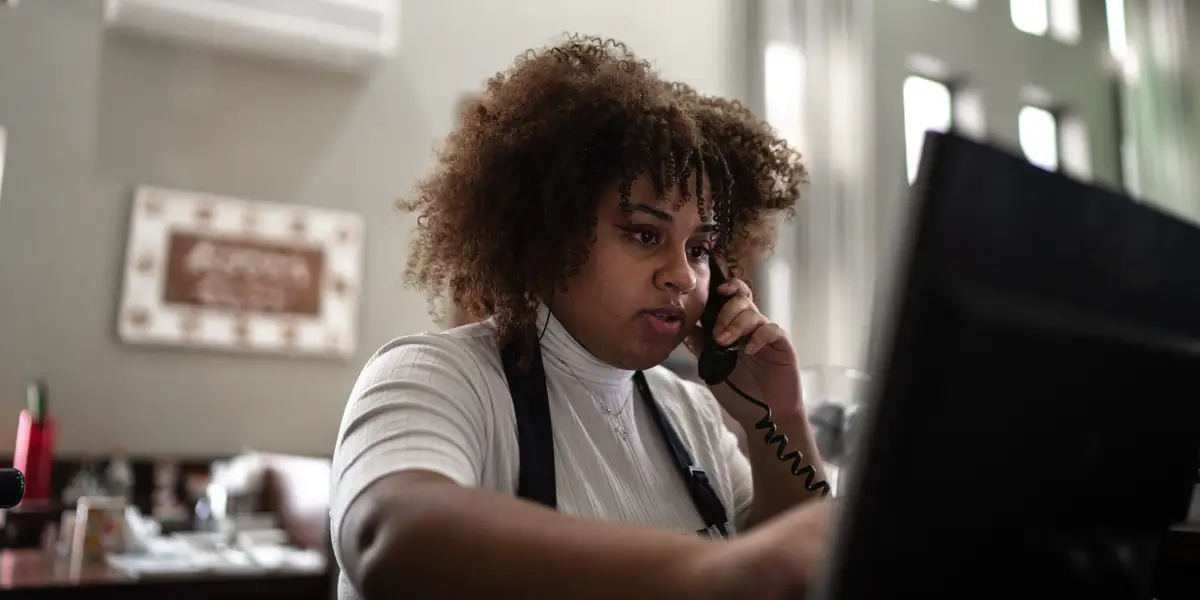
The assumptions have stood for a decade: Everyone carries a phone, people prefer text messaging to making calls, and the business phone system belongs in the same drawer as the fax machine. But the data tells a different story, and unlike the fax machine, the phone system isn’t archaic hardware. It’s a means of doing business, built to run inside a mobile-first world.
Read more Stripe says the singularity has arrived. Here’s what they told investors about it.
A 2025 YouGov survey found phone calls remain the way Americans most prefer to contact a business. And that’s not a generational holdover. A 2025 McKinsey report states that 71% of Gen Z consumers see a live call as the fastest way to resolve a customer service issue. That stat upends the assumption that digital natives prefer text or nothing.
The phone, in other words, is still where small businesses win or lose customers. What’s changed is what a “phone system” can offer. Running a company on personal cell phones might feel like an easier, more cost-effective choice, but it comes with risks.
The problem with relying on the phone in your pocket
Many small businesses start this way: The founder’s cell becomes the business line. It’s listed on the website, the invoices, and the truck.
Then, inevitably, a customer calls when the founder is away on school pickup and lands in a full voicemail box. A prospect sees a mobile number on a proposal and draws conclusions. An employee leaves, and the clients attached to their mobile number go with them.
This is an issue of infrastructure, not technology. A business needs one number that represents the company, and it needs that number to route intelligently, transfer cleanly, and survive turnover. That layer is a phone system. For cloud-based calling, the supporting connection matters, too. Spectrum Internet is powered by a fiber network and delivered via a hardwired broadband line.
Modern phone systems build trust and help capture every opportunity
The cost is easy to underestimate because missed calls are hard to track. The customer who calls a bookstore on Friday night and hits a full voicemail box may scroll to the next search result instead of trying to call again on Monday. In that scenario, the sale is lost, and the bookseller never learns it existed.
There’s a related trust problem on outbound calls. Hiya’s 2026 State of the Call report shows that 86% of unknown calls go unanswered, with Americans getting nearly 10 calls a week from an unknown number. The difference between a callback that connects and one that gets screened is a recognizable, consistent business number.
Modern systems attack the problem from all directions. An auto-attendant gets the Friday-night customer to a person instead of a dead end. Whatever voicemail does get left arrives transcribed in an inbox, where Friday night’s call becomes Saturday morning’s task instead of a lost sale. And because call screening has been filtering robocalls all week, the line was clear to receive it in the first place.
Read more Trump says data centers maybe ‘could use a little public relations help’
The system moved into the phone
Today’s business phone systems don’t compete with mobile phones: They run on them. What that buys a small business is continuity. A cloud-based platform treats the business number as software. It rings the desk phone and the cell simultaneously, and it lives in an app on whatever device is nearest. Spectrum Business Internet® offers speeds up to 2 gig in many areas, giving growing businesses a range of speed options for connected tools and communications.
For businesses with distributed teams, Spectrum Business® Connect with RingCentral brings calls, HD video, team messaging, and voicemail transcription into one app. It also integrates with tools such as Google Workspace and Salesforce. When a business owner takes a call from the road, the caller thinks they’re calling a company, not a cell phone.
For a business with a storefront or office, Spectrum Business Voice® offers reliable calling with 35-plus features. The desk line and cell behave as one, so the owner can phone a backlist reorder into the wholesaler from the sidewalk, using the store’s number.
Both Spectrum Business phone options let business owners keep their existing numbers, helping preserve customer recognition and continuity.
The importance of sounding like a company
There’s a compounding return on all of this. When a caller gets a clean menu, a short wait, and a person who can help, they extend a measure of trust before any money changes hands. The same goes for a professional voicemail that gets returned promptly. For a five-person company, a real phone system provides a layer of legitimacy and confidence.
The mobile-first world didn’t retire the business phone system. Instead, it clarified what the system was always for: one number, smart routing, professional presence, and continuity, no matter who’s working or where they work. Customers went mobile years ago. The businesses winning their calls are the ones whose systems went with them.
Explore how Spectrum Business phone solutions keep small businesses connected in a mobile-first world.
This sponsored post was created by BI Studios with Spectrum for Business.
About the Author