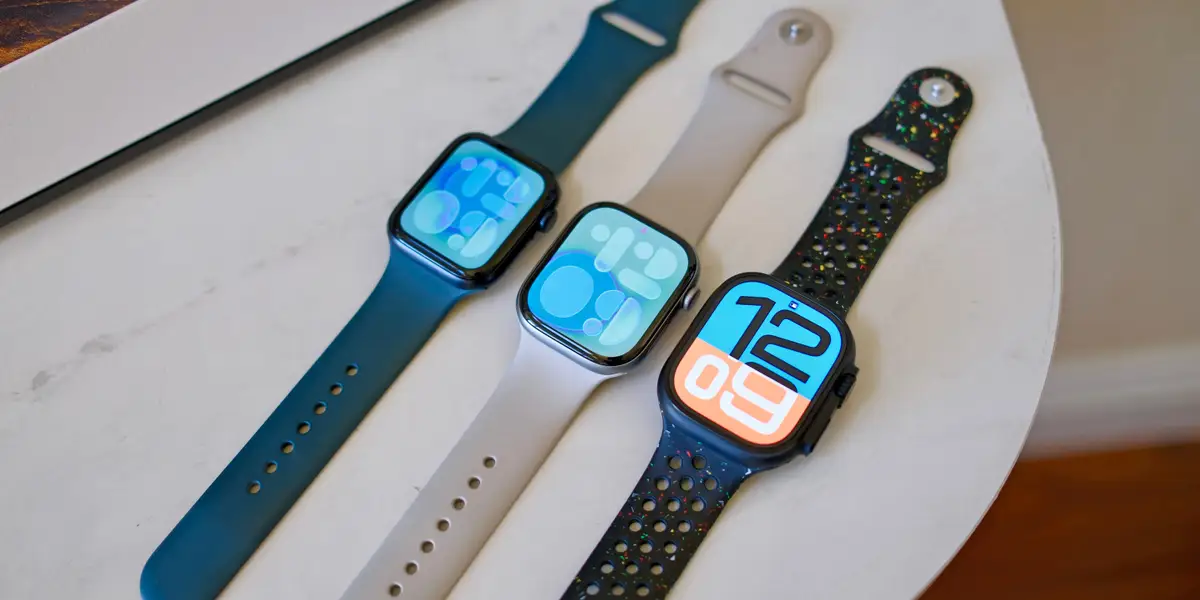
The Apple Watch remains the gold standard for what users should expect from a smartwatch. It handles the everyday stuff — texts, notifications, workouts, sleep tracking — so seamlessly that it can quickly become one of those gadgets you barely think about but use constantly. The hard part is choosing the right one. Apple’s current lineup includes three models at different prices, and the best Apple Watch for you depends on what you actually want from it. That’s where I can help.
Read more OpenAI president says companies should do 10 things ASAP to defend against AI cyber threats
I’ve been wearing an Apple Watch since the original model arrived in early 2015. In the decade since, I’ve tested every generation and have personally owned several models. The basic design may look familiar, but Apple has steadily refined the watch over the years, with newer options bringing meaningful upgrades to performance, health and fitness features, displays, battery life, and durability.
After testing the latest lineup, the Apple Watch Series 11 stands out as the best Apple Watch for most people. It has the most balanced mix of features and the sleekest design. Meanwhile, the budget-friendly Apple Watch SE 3 is the better choice if you want to spend less, and it’s especially appealing to teens. But if you’re a serious runner or outdoor enthusiast, the high-end Apple Watch Ultra 3 is the ideal pick. Below, I’ll break down what each Apple Watch does best, where it comes up short, and which one makes the most sense for you.
Our top picks for the best Apple Watch
Best overall: Apple Watch Series 11 – See at Amazon
Best on a budget: Apple Watch SE 3 – See at Amazon
Best for outdoor enthusiasts: Apple Watch Ultra 3 – See at Amazon
Best overall

The latest Apple Watch boasts improved battery life and 5G connectivity (on the cellular model). It’s the most well-rounded smartwatch for iPhone users, offering polished fitness tools and seamless integration with your daily life.
What we like
What we don’t like
The Apple Watch Series 11 is the best Apple Watch for most people. It’s not Apple’s cheapest or most advanced model, but it nails the basics with a bright, easy-to-read display, smooth performance, and tight iPhone integration. It offers nearly everything typical smartwatch users need, and it does so in style, with the widest range of color options and the sleekest form factor.
The Apple Watch Series 11 debuted in late 2025 and starts at $399. You can choose between 42mm and 46mm sizes, with GPS-only or cellular connectivity (with a paid plan). Unlike the previous Series 10, which was limited to LTE, the Series 11 steps up to 5G for faster speeds. It also boasts slightly longer battery life than its predecessor, reliably lasting through a full day. It’s not a dramatic leap over the Series 10, but you do get other small quality-of-life upgrades like stronger, more scratch-resistant glass.
Of course, you also get the usual assortment of core smartwatch features, including support for texting, calls, music playback, and other apps when paired with an iPhone, WiFi, or a cellular connection. It also includes a bevy of sensors for health tracking. It’s in that area where the Series 11 has the biggest leg up over the cheaper SE 3.
The Series 11 features an electrical heart sensor, a blood oxygen sensor, a water depth meter, and a water temperature sensor, all of which are missing from the SE 3. As a result, the Series 11 can deliver on-demand ECG readings to detect AFib. It can also provide hypertension notifications. These features help cement the Apple Watch Series 11 as one of the best fitness trackers for everyday workouts and health monitoring.
However, some dedicated athletes may prefer the pricier Ultra 3, which has a few extra design touches and features that make it a bit more friendly for outdoor adventurers. For instance, as a daily runner, I wish the Series 11 had the Ultra 3’s Action Button, which allows you to start workouts with a single press. I also found the Series 11’s curved glass screen to be tricky to tap while running.
But while serious athletes may want more specialized features, the Series 11 strikes just the right balance for most use cases. If you don’t already own a recent Apple Watch and want the best overall value in Apple’s lineup, the Series 11 is the one to buy.
Read our full Apple Watch Series 11 review.
Best on a budget

The Apple Watch SE 3 marks the most capable generation of the brand’s budget smartwatch yet. It now comes powered by the S10 chip, with better battery life, and an always-on display.
What we like
What we don’t like
The Apple Watch SE 3 is a great smartwatch for kids, teens, and anyone on a budget. The SE 3 starts at $249 for the smaller 40mm size. But even with the larger 44mm size and cellular connectivity, the most you can spend on the actual watch is $329. (A fancy stainless steel band will bump the highest configuration to $379.)
For the lower price point, you might expect to give up speed, storage space, or things like sleep tracking, but you don’t. The SE 3 has the same S10 processor and 64GB of storage as the Apple Watch Series 11. The SE 3 can track sleep, ovulation, and wrist temperature, and provide sleep apnea notifications.
Where the SE 3 is most visibly lacking is its screen. It has a lower peak and off-axis brightness and fewer pixels along the edges of the display. But in practice, I barely noticed those things. The SE 3 looked great on my wrist. It was only when I was comparing it directly to the other Apple Watches that I preferred the Series 11 and Ultra 3.
The SE 3 also falls short in terms of health sensors, lacking an electrical heart sensor, a water-temperature sensor, and a depth sensor. It’s also missing support for Apple’s blood oxygen app. If you want the ability to take ECG readings for AFib detection, the SE 3 isn’t for you. It also won’t alert you to hypertension. But be aware that Apple says both of those features are intended for people over 22. That’s one reason the SE 3 is a better fit for kids and young adults.
The SE 3 can still track sleep, record workouts, stay on top of communication, and do most of the other things you want a smartwatch for. Despite a few limitations, in my use, it performed well, and it’s easily the best Apple Watch for budget shoppers the brand has ever released.
Read our full Apple Watch SE 3 review.
Check out our Apple Watch SE 3 vs. Apple Watch Series 11 comparison.
Best for outdoor enthusiasts

The Apple Watch Ultra 3 is the latest version of the brand’s top-tier smartwatch. It’s designed for outdoor enthusiasts and boasts the largest display and longest battery life for an Apple Watch to date. It also supports two-way satellite communication.
What we like
What we don’t like
The Apple Watch Ultra 3 is the best Apple Watch for people who demand advanced fitness performance and a rugged design for intense physical activity. This model has features that make it perfect for outdoor enthusiasts, including an extra-long 42-hour battery life, the brightest screen of any Apple Watch, a tough design, and an Action Button that can serve as a workout shortcut. After wearing the original Ultra and now the Ultra 3 full-time, I’ve found all those things quite useful in practice.
My exercise of choice is running daily. I assigned the side Action Button to automatically start an outdoor running workout whenever I press it. The button can also be used during workouts to mark segments.
If you are a runner too, the dual-band GPS will help the Ultra 3 lock on to a signal in densely populated areas, and it’s more accurate than the standard GPS on the Series 11 for people running races. This could also be a worthy feature for hikers. Additionally, the Ultra 3 has a siren if you’re ever lost off the path and need to set off a loud noise.
Read more Billionaire investor Jeff Gundlach warns of a market top as AI chips become a ‘new asset class’
In terms of sensors and health features, the Ultra 3 matches the Series 11. It can send hypertension notifications to alert about blood pressure and take ECG readings to detect AFib. You can use the Ultra 3 for sleep tracking if you want. But personally, I’ve found it a little disruptive to use while sleeping because of its larger size.
The other areas the Ultra 3 outdoes the Series 11 are with its brighter display, up to 3,000 nits of peak brightness, compared to 2,000 on the Series 11. The Ultra 3 is also water-resistant to 100 meters and has a depth gauge to 40 meters. For these reasons, the Ultra 3 is a good option for divers, swimmers, and surfers.
However, the Ultra 3 is the most expensive Apple Watch, and its extra features are really only needed if you spend a lot of time outdoors or in the water. In that context, average users are better off saving money with the Series 11 or SE 3.
The best Apple Watches, compared
| Apple Watch SE 3 | Apple Watch Series 11 | Apple Watch Ultra 3 | |
| Best for | Budget shoppers, kids, and teens who want the core Apple Watch experience | Most iPhone users who want the best balance of features, design, health tracking, and price | Runners, hikers, divers, swimmers, surfers, and serious outdoor athletes |
| Skip this if | You want ECG, blood oxygen, hypertension notifications, or more advanced sensors | You already own a recent Apple Watch and don’t care about incremental upgrades, or you want the Ultra’s specialized features | You’re an average smartwatch user, want something comfortable for sleep, or can’t justify the higher price |
| Starting price | $249 | $399 | $799 |
| Size options | 40mm or 44mm aluminum | 42mm or 46mm aluminum or titanium | 49mm titanium |
| Brightness | Up to 1,000 nits | Up to 2,000 nits | Up to 3,000 nits |
| Battery | Up to 18 hours | Up to 24 hours | Up to 42 hours |
| Sensors |
|
|
|
How we test Apple Watches
I’ve worn and tested every generation of Apple Watch, with regular hands-on use across all current models. I’ve also managed multiple Apple Watches for family members, giving me firsthand experience with everything from initial setup to long-term use.
To compare the best Apple Watches, I aim to use each model as it’s intended in day-to-day life. That includes simply wearing it at work and while traveling, as well as tracking a wide range of activities — running, rowing, swimming, HIIT, yoga, and more — while also exploring less-used features like noise alerts, the siren, and Walkie-Talkie. However, some capabilities, such as Crash Detection, can’t be safely tested in real-world conditions.
Ongoing daily use across generations has also given me a strong sense of real-world battery life and how much activity each model can handle before needing a recharge.
While I primarily test the latest hardware and software, I also revisit older Apple Watch models to evaluate performance over time, including any signs of slowdowns or other issues.
Meet the expert behind this guide:
Tyler Hayes, contributing reporter: I cover consumer tech for Business Insider, and over the past decade, I’ve written about everything from wearable devices to speakers and smart home gear.I’ve been testing Apple Watches since the very first model, and I’ve spent years living with them day-to-day, at work, on commutes, during exercise, and while traveling. My approach is simple: use each smartwatch the way you actually would to figure out what’s genuinely useful (and what isn’t) and help you decide which model is the best Apple Watch for your needs.
Learn more about the Reviews team at Business Insider.
Apple Watch FAQs
When will 2026 Apple Watch models be available?
Apple is expected to announce new 2026 Apple Watch models in early September. This is traditionally when the brand holds its annual iPhone and Apple Watch product launch event.
Though nothing has been confirmed yet, industry rumors point toward an Apple Watch Series 12 and Apple Watch Ultra 4 making their debut at the briefing. Bloomberg reports that the new models will likely use upgraded chips for faster performance. A new Apple Watch SE model is not expected to be released this year.
Are older Apple Watch models still worth it?
Amazon and other retailers may still carry previous Apple Watch models, especially refurbished options. However, I don’t recommend buying anything before the Series 6 or SE 2 because those don’t support the latest software, watchOS 26.
Be aware, even if a watch supports the latest software, like a Series 6, you will likely notice some sluggishness. Though you may save some money by hunting down an older or refurbished Apple Watch, I suggest sticking to a Series 8 or newer in 2026 for the best performance.
What’s the difference between GPS and GPS + Cellular Apple Watch models?
A GPS-only Apple Watch connects to an iPhone over Bluetooth and WiFi and gets its internet connection from the phone. A GPS + Cellular Apple Watch can still connect to an iPhone with Bluetooth and WiFi when it’s within range of your phone, but when it’s separated from the phone, it can connect directly to a cellular network.
The benefit of the GPS + Cellular Apple Watch is that you can leave your phone behind and still receive texts and notifications, and stream music. Cellular Apple Watches cost a little more, and you’ll also need to pay a monthly cell service fee.
Do Apple Watches work with Android?
No. As of 2026, an Apple Watch will not work with an Android phone. If you use an Android phone, you should consider a smartwatch from Google, Samsung, or Garmin.
For recommendations, check out our guide to the best Garmin watches.
You can also browse models from other brands on Amazon’s full smartwatch listing.
Is the Apple Watch waterproof?
The best Apple Watches are water-resistant up to at least 50 meters. The most rugged Apple Watch, the Ultra 3, is water-resistant to 100 meters. All watches are fine for swimming, surfing, or showering.
The Ultra 3 is suitable for diving to a depth of 40 meters. It has a depth sensor and a water temperature sensor, making it great for use recreational use in the water.
Read more First came self-driving cars. Now, Waymo veterans are building autonomous construction equipment.
About the Author