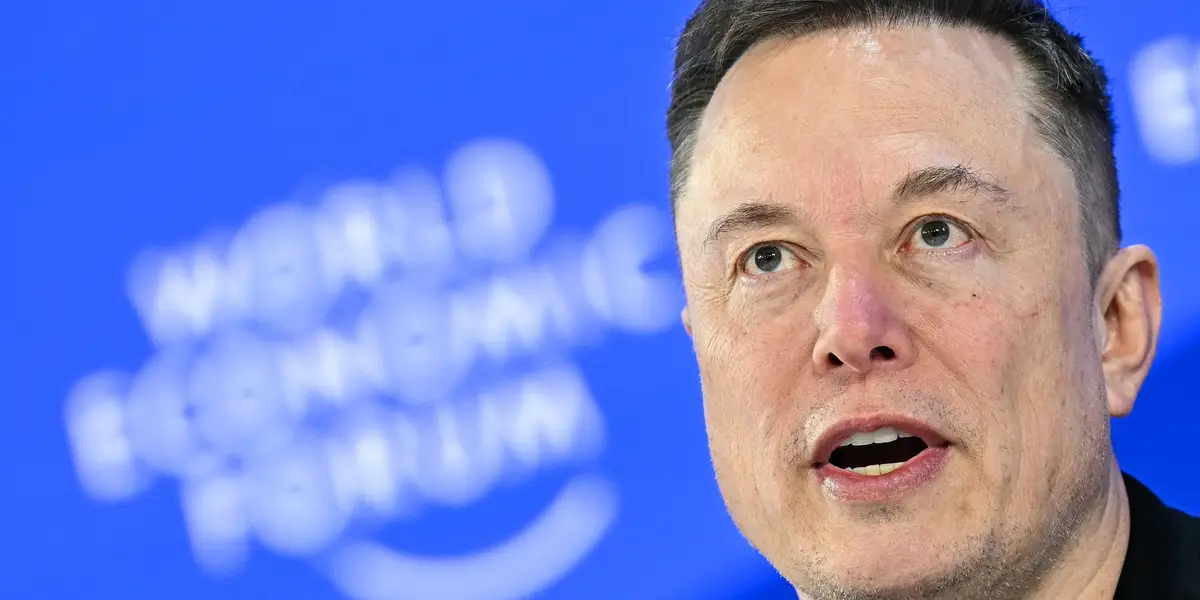
Elon Musk issued a jaw-dropping revenue forecast, ridiculed the ease of building data centers compared to rockets, and envisioned factories on the Moon during SpaceX’s first earnings call on Tuesday.
Read more Citadel’s purchase of Situational Awareness’s portfolio fuels Ken Griffin’s record-setting July
The Tesla and SpaceX CEO — who is well-known for his grandiose predictions — also touted Starlink’s potential for global domination, and predicted AI will become dramatically more advanced by the end of next year.
Here are Musk’s five most interesting comments during SpaceX’s inaugural earnings call after its blockbuster market debut in June.
1. Rocketing revenue
Musk told Wall Street analysts that SpaceX’s internal projections have it reaching $1 trillion in revenue in 2030, instead of 2031 as it had forecast before its IPO. He also said there’s a “nonzero chance of that being in 2029.”
To put that in perspective, Walmart and Amazon, which generate more revenue than any other public companies, reported net sales of $706 billion and $717 billion, respectively, in their last full financial years.
SpaceX generated $12.5 billion in first-half revenue, a 54% increase from the same period in 2025.
From fully autonomous vehicles to the first crewed mission to Mars, Musk has a long history of setting ambitious timelines for milestones, only to fail to meet them.
He acknowledged back in 2018 that he’s “typically optimistic” about when things will occur, but added that what he predicts “pretty much always happens, but not exactly on the timeframe.”
2. Data centers vs. rockets
Musk said that building data centers “ain’t rocket science,” whereas building rockets is extremely challenging because they “desperately want to blow themselves into tiny pieces.”
He quipped that tasking rocket engineers to construct data centers was “kind of ridiculous, frankly,” and represented a “trivial problem” for them.
Musk quipped that it was like the “New York Yankees going in and playing a Little League team.”
Big Tech companies, including Microsoft, Meta, Amazon, Alphabet, and Oracle, are pouring hundreds of billions of dollars into building data centers to power the AI revolution.
Read more Meet 4 of the people who made it to the top of McKinsey this year
The immense demand for microchips, power, and water has strained supply chains and pressured energy grids and reservoirs.
3. Linking up the world
Musk said it’s “not out of the question” that Starlink will eventually deliver a “majority of the world’s internet, at least in countries where we’re allowed to operate, which is the vast majority of countries.”
In another example of his famously optimistic timelines, Musk added that it won’t be in the “infinity future” but rather in “less than 10 years.”
Starlink, the satellite-communications arm of SpaceX, has emerged as a key provider of internet to planes, ships, and far-flung locales.
However, it has yet to meaningfully disrupt the core urban broadband businesses of established internet providers such as T-Mobile and Verizon.
More coverage of SpaceX’s first earnings report
SpaceX’s science fiction dreams come with an astronomical bill
SpaceX and Nvidia are taking their relationship exclusive — here’s what Musk said about their new status
SpaceX says it’s coming for AT&T, Verizon, and T-Mobile customers
SpaceX earnings recap: Stock drops 7% after first post-IPO report reveals higher than expected AI capex
4. Mission to the Moon
Musk predicted that SpaceX will build “factories on the Moon,” and “robots will be helpful with that.”
He acknowledged that “sounds like super sci-fi right now,” adding it might seem “totally nuts” but “you can probably scale to 1,000 times the economy of Earth in terms of intelligence launched into space, but probably maybe even 1 million times.”
5. Getting smarter
Musk hailed the launch of Claude 4.5 last September as “one of the milestones and a credit to Anthropic.”
He said it was a “shock to the system” how good the AI model was.
Musk pointed to the immense progress in AI over the past two years, saying models from two summers ago feel like they “should be in a museum.”
Based on recent rates of improvement, Musk said that by the end of next year, it’s “not clear to me that there’s anything that — digital at least — that AI won’t be able to do.”
Read more What Leopold Aschenbrenner can learn from Warren Buffett after his $45 billion AI fund imploded
About the Author