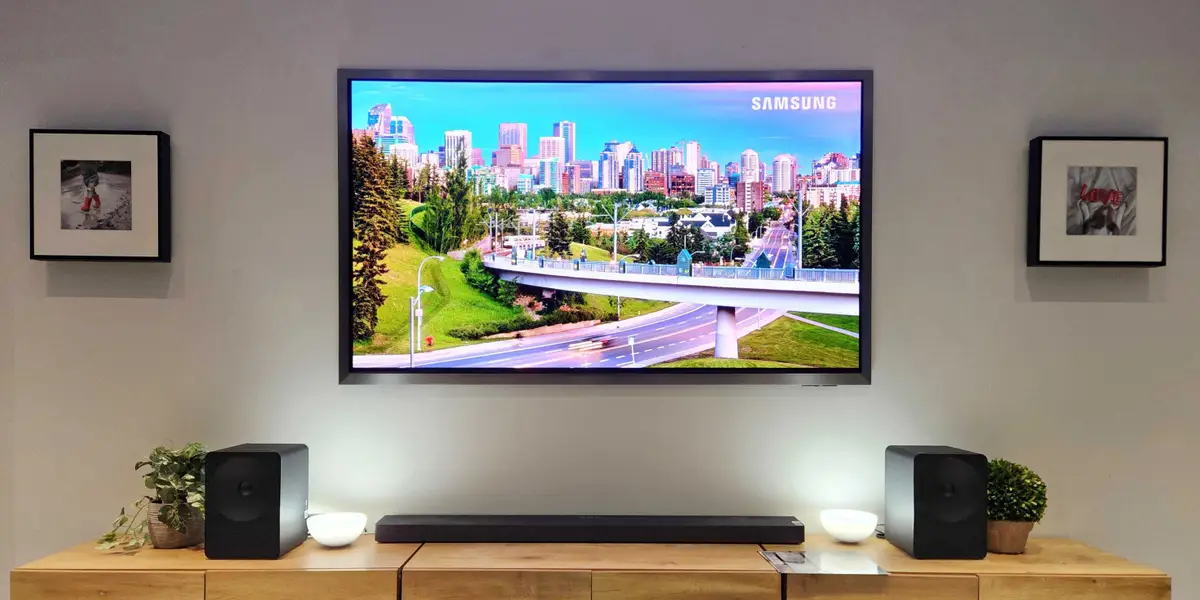
The Samsung S95H is the brand’s latest premium OLED TV, and it’s easily one of the most impressive displays you can buy right now. This is the company’s brightest OLED yet, and it’s also the brightest OLED I’ve tested, period.
That’s a big deal. For years, Mini LED TVs have had a clear advantage over OLEDs in sheer brightness. OLEDs have remained the go-to option for pixel-level contrast and perfect black levels, but Mini LED models have been better equipped to deliver the kind of punchy picture that stands out in rooms with a lot of light. The S95H is closing that gap.
The TV also boasts a few interesting but divisive design choices that help it stand out as a living-room centerpiece. It’s expensive, but it feels every bit like a flagship display, with a metal frame-like bezel, access to Samsung’s Art Store, and the latest version of the company’s love-it-or-hate-it glare-free screen.
After extensive hands-on testing with the TV — both during a pre-release demo session at Samsung’s New Jersey facility and across several weeks in my own home office review space — I’ve been genuinely floored by how well the S95H performs in a variety of room types. This isn’t just the best Samsung TV for high-end image performance; it’s one of the best TVs for picture quality ever made.

The S95H is Samsung’s 2026 flagship OLED TV, and it’s one of the most impressive displays the brand has ever made. It boasts record-level brightness for an OLED and a unique frame-like design.
What we like
What we don’t like
The S95H has a unique but divisive design
The Samsung S95H is the brand’s flagship OLED for 2026, sitting above the midrange S90H and entry-level S85H. It’s available in screen sizes ranging from 55 to 83 inches. I tested the 65-inch model for this review. Here’s a full rundown of retail pricing:
Though Samsung doesn’t reveal exactly what kind of OLED panel it uses on different sizes, based on previous versions of this TV and my testing, it appears that the 55-, 65-, and 77-inch S95H feature Samsung’s latest-generation QD-OLED panel. The larger 83-inch size is likely using a four-stack tandem OLED panel. This should result in similar brightness across the board, but the 83-inch model’s color range may be slightly narrower than its smaller counterparts.
From a design perspective, the S95H takes a bold stance with a unique bezel that draws attention. Samsung calls this its “FloatLayer Design.” The TV has a metal frame-like border, with the panel appearing to float in front of it. In person, it looks rather stunning on a wall. The frame adds a premium touch that really helps the TV stand out, and the set can be installed virtually flush with almost no gap.
That said, this is a strong aesthetic choice that won’t fit all room decors or personal tastes. I think it works well when mounted, but I don’t love how it looks when placed on a media console. The TV includes left and right feet that snap into place for easy installation, but the massive silver bezel just looks odd on a stand. This is clearly a TV designed for mounting, and that’s how I’d recommend setting it up.
The S95H uses the latest version of Samsung’s anti-glare screen technology, featuring a matte-like finish that significantly reduces reflections. This remains one of Samsung’s most divisive TV features, but if you regularly struggle with glare, it’s a true game changer. In my home office, it eliminated the mirror-like reflections I see on typical glossy TV screens and reduced glare to a diffuse sheen that was barely visible when watching content.
However, there is still a trade-off. The glare-free coating makes black levels appear slightly elevated when the screen is exposed to light. This was definitely evident during my testing, but the effect was less noticeable than on previous S95 TVs. Though I used to prefer glossy OLEDs because of this side effect, I’m now torn about which kind of screen I like best. If reflections are a major pain point in your room, the positives of the anti-glare screen outweigh any negatives.
When it comes to connections, the S95H features four HDMI 2.1 ports. But unlike last year’s S95F, which came with a separate One Connect Box for its inputs, these ports are now built into the back of the panel, as on most TVs. However, the S95H is compatible with Samsung’s Wireless One Connect Box (sold separately), so you can still use that setup if you prefer. The Wireless One Connect Box also features four HDMI 2.1 ports, so if you use it in conjunction with the TV’s ports, you get a total of eight — the most on any consumer TV.
Samsung also includes its SolarCell remote. The remote has a compact, minimalist design and doesn’t need batteries. Instead, it can recharge using sunlight or indoor light, which remains a very cool feature. But I don’t love the remote’s overall design. It’s not backlit, and it feels a bit cheap in hand compared to some other premium TV remotes.
The S95H delivers near reference-level image quality
The S95H absolutely wowed me with top-notch image quality, delivering some of the best overall picture performance available. Like all OLED TVs, it offers an infinite contrast ratio, allowing each pixel to dim and brighten independently. In a dark room, black levels completely disappear, producing the inky depth OLEDs are known for.
Viewing angles are also wide, so colors and contrast don’t fade when you watch from an off-center position. And though some LG OLEDs are prone to a slight green tint at an angle, the Samsung S95H is completely free of this flaw. For gaming, the S95H supports a fast 165Hz refresh rate, which is a nice perk for PC users who want smoother performance with compatible hardware.
But what really sets the S95H apart from other high-end OLEDs is its brightness. Using a colorimeter and Portrait Displays’ Calman software, I measured a peak brightness of 2,780 nits during my visit to Samsung’s New Jersey facility and 2,644 nits when I tested a second unit at home. This was on a 10% test pattern in the TV’s HDR Filmmaker mode. The slight discrepancy between the two units can likely be chalked up to normal panel-to-panel variation and newer firmware, but either way, that’s class-leading brightness.
Now, 2,780 nits still can’t match the absolute brightest TVs available, like the TCL X11L, but the S95H is close to flagship Mini LED territory, which used to be unthinkable for an OLED. It’s also a nice bump over last year’s already excellent S95F, which delivered 2,170 nits in the same test, and a notable upgrade over the cheaper Samsung S90H, which offers around 1,440 nits.
Color measurements were also extremely impressive. I measured 100% of the P3 color space used in most modern Hollywood productions and about 81% of the wider BT.2020 color space. That’s not as high as Samsung’s R95H Micro RGB TV, which can hit 91% of BT.2020, but it’s an excellent number for an OLED. This is a result of the panel’s quantum-dot technology, which helps the TV deliver a wider, brighter color range than a standard OLED. Though most current movies and TV shows don’t require such high BT.2020 coverage, that could change as more filmmakers start taking advantage of the gamut.
The TV’s color accuracy was also exceptional right out of the box. I measured an average DeltaE value of just 1.1 in HDR Filmmaker mode. The lower the DeltaE, the more accurately the TV displays colors. Anything under three is hard for the human eye to notice, so the S95H is top-tier without any further tweaking needed. Color gradients are also smooth, even in tricky scenes from movies like “Ex Machina” and “The Green Knight,” which can appear blocky on lesser displays.
Colorful, bright movies like “Mad Max: Fury Road” and “Aquaman” looked fantastic on the S95H. Both films are great showcases for bold HDR, and the S95H delivered vibrant, impactful images with highlights that really popped. The TV’s combination of high brightness and rich color gives these kinds of movies a level of intensity that midrange OLEDs can’t match.
The S95H also impressed me with darker material. The burning church scene in “1917” had excellent black levels, and the TV maintained good shadow detail. This is where OLED’s pixel-level precision remains a big advantage over Mini LED and RGB LED models. Even the best LED-based TVs need to rely on dimming zones, which can sometimes lead to blooming or uneven black levels. The S95H doesn’t have that issue because it doesn’t have a backlight. Dark areas remain even and precise.
That said, as I mentioned in the design section, those black levels do take a slight hit with the lights on because of the TV’s anti-glare screen. When I watched the opening scene from “The Matrix” in a bright room, black levels still looked decent, but they weren’t as inky as they were in the dark. This is something to keep in mind, but it’s an acceptable tradeoff for people who hate reflections.
I’ve tested all the best TVs over the last few years, and the S95H’s picture performance is easily among the most impressive I’ve ever seen. This is about as close to reference-level image quality as a consumer TV can get, and it’s perfect for enthusiasts who want an accurate, bold, high-contrast TV.
When it comes to rival displays, only the Sony Bravia 9 II True RGB and LG G6 OLED can really compete with the S95H’s picture. The Bravia 9 II can produce an even brighter, more colorful image, but its viewing angles and contrast aren’t as good as the S95H’s. Meanwhile, the G6 offers a very similar array of pros and cons to the S95H, but I need more hands-on time with it to deliver a full verdict. That said, the most notable difference between the two is actually their screen coating. The G6 has a glossy panel that’s better at preserving black levels but worse at fighting reflections.
Samsung’s Tizen interface has been tweaked with a cleaner layout
Samsung’s Tizen smart TV system is solid, but it’s still not my favorite platform. I give an edge to systems like Google TV and Roku, which I find a bit more reliable and helpful. Still, Tizen is decent enough with all the functions and apps most users need. The interface has also been tweaked for 2026.
Various pages are now kept in a horizontal menu at the top of the screen rather than a vertical menu on the left. Content recommendations are also less pushy, which makes the homepage feel cleaner and easier to navigate. This is a welcome change overall, but it also gives the homepage a more sparse look. Some users will prefer this less cluttered design, while others may find it a little barebones.
Voice control is available using Bixby or Amazon Alexa, and you can activate it with the included remote or hands-free with the TV’s built-in mics. Samsung’s Gaming Hub is also included, which offers access to cloud services like Xbox Game Pass.
Navigation was generally smooth and pain-free, but the Xbox app felt a bit laggy when moving around. I also encountered one minor snag when the YouTube app crashed while I was playing a video at 1.5x speed. I also don’t love that the TV automatically loads the last app or source you had open when you turn it on. I’d prefer that it just stay on the homescreen.
The S95H is the first Samsung OLED to offer access to the brand’s Art Store. This lets the TV display classic and contemporary artwork when you’re not watching something. A subscription is required for the full catalog, but Samsung includes a rotating selection of 30 free pieces each month.
That’s a nice bonus for users who want the TV to double as a decor piece in their living room, and it complements the S95H’s metal frame bezel perfectly. Samsung’s Frame TVs are still the brand’s most decor-focused displays, but the S95H’s design and Art Store access give it some of that same lifestyle appeal while delivering flagship OLED performance.
Microsoft Copilot AI is also integrated, bringing chatbot-like capabilities to the TV. It’s a convenient extra, but not essential. While it’s neat to ask your TV for restaurant recommendations, help plan a vacation, or answer detailed questions, I can do those things just as easily on my phone or laptop. That said, this worked pretty well, with conversational answers, though it did crash once when I asked it where to stream certain movies.
Should you buy the Samsung S95H OLED TV?
The Samsung S95H combines everything I love about OLED — pixel-perfect contrast, wide viewing angles, and deep black levels — with brightness that gets shockingly close to flagship Mini LED territory. Its color performance is also one of the best I’ve measured on an OLED.
Samsung’s glare-free screen tech makes this an excellent TV for sunny spaces and dedicated home theaters. Though some people will still prefer a glossy screen, which preserves contrast better in bright rooms, the anti-glare coating should be a huge selling point for viewers who regularly struggle with reflections. And though the metal bezel design is divisive, I think it looks great when mounted on a wall.
So long as you’re not turned off by its design choices, the Samsung S95H is a stunner and easily one of the top three high-end TVs released this year. I still need to test LG’s rival G6 OLED, but the S95H could end up being my new premium TV pick. It’s expensive, but it backs up its premium price with premium performance.
About the Author