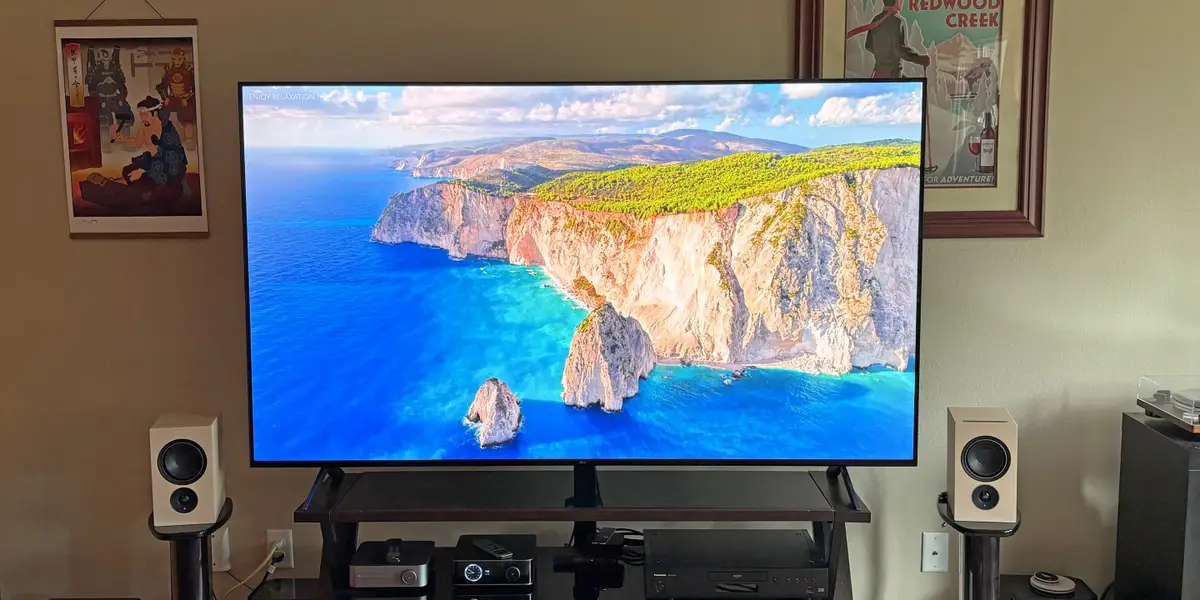
The RGB TV age has arrived. You can now choose from multiple models and brands that use this new tri-colored backlighting tech to provide enhanced colors, higher brightness, and other potential advantages over traditional LEDs. LG’s new MRGB95B Micro RGB TV stands out for both its lofty claims and its lofty price.
Read more AI and the memory crunch are in focus ahead of Apple earnings and Tim Cook’s last call as CEO
As promised, the TV delivers outstanding brightness, alongside great image clarity, impressive motion processing, and color reproduction that’s among the most vibrant and engaging I’ve tested. However, drawbacks like its mediocre off-axis viewing and light bloom (or haloing) in challenging scenes can’t keep up with the best OLED TVs or even some cheaper backlit models with competing tech, like TCL’s new SQD models.
That’s frustrating at this price, as are some usability quirks like LG’s stubborn refusal to bring back the mute button for its Magic Remote. Even so, I couldn’t help being impressed, and sometimes enamored, with the Micro RGB’s fantastic brightness and colors. I still prefer LG’s OLED models for their superior contrast, but if you want a really big screen that dazzles in the most dynamic scenes, the LG 95B Micro RGB has spectacle to spare.

The LG 95B-Series is a solid Micro RGB TV with dazzling color and brightness. However, blooming, mediocre off-angle viewing, and a steep price keep it from besting the brand’s less expensive OLEDs.
What we like
What we don’t like
A minimalist design with advanced features
Designed as a big-screen option, the MRGB95B Micro RGB TV comes in just three sizes, starting with the 90-pound 75-inch model I reviewed, and going up to 86- and 100-inch sizes. Even at scale, the TV is relatively easy to assemble, with blade-like stands that attach much faster than fancier pedestals, and I appreciate the option to position the stand inward or outward to accommodate your setup.
The TV’s stripped-down design looks slick if nondescript, with a flat backside that mounts flush to your wall and slim black bezels that virtually disappear in low lighting. Maybe the most noticeable design feature is its glossy screen, which more readily reveals reflections like my kitchen bar than my favorite premium TVs or cheaper matte-screen models like the Hisense U7SG.
On the left side of the screen are plenty of inputs, including four HDMI 2.1 ports with support for gaming features like ALLM (Auto Low Latency Mode) and VRR (Variable Refresh Rate) at up to 165Hz, keeping pace with top rivals. Following an unfortunate trend, the TV’s tuner doesn’t support ATSC 3.0 for NextGen features like 4K HDR broadcasts, and LG continues to omit DTS support for Blu-ray soundtracks. In any case, the Micro RGB’s onboard sound quality is middling at best, so you’ll want to connect a soundbar or other audio device.
Like all LG TVs, HDR support excludes the HDR10+ format, but includes its more common rival, Dolby Vision, along with HDR10 and HLG. You can learn more about these formats in our HDR explainer. LG’s latest Dolby Vision picture modes also simplify setup, with common options like Filmmaker and Cinema Home replacing the Dolby Vision Dark and IQ modes found on older LG models. I made only mild tweaks to the picture, including disabling the light sensor that adjusts screen brightness to your environment, found in both Energy Saving and within each picture mode.
The LG Micro RGB’s advanced colors and searing brightness are stunning
Even in this new era of increasingly bright TVs, LG’s Micro RGB is a stunner. Like other RGB LED displays, it uses separate red, green, and blue diodes in its backlight to produce a wider range of colors. And like Samsung, LG brands its version of RGB backlighting as Micro RGB since its light modules are designed to be smaller and more precise than typical Mini LEDs.
Using a Portrait Displays C6 HDR5000 colorimeter, a G1 pattern generator, and Calman software, I measured peak brightness at around 3,400 nits, which blasts well beyond current OLED tech. Thankfully, the TV handles its potency with relative restraint. While the panel’s light output doesn’t perfectly follow the filmmakers’ intent, it rarely gets uncomfortably bright, mostly saving its potency for content that really calls for it, like extra-bright 4K HDR Blu-rays such as “Mad Max: Fury Road.”
That film’s intense sandstorm chase is depicted with particular shock and awe. The strobe-like orange-and-white lightning blasts were hypnotically beautiful, with no noticeable clipping, enhancing the film’s urgency and artistry. Less potent streaming content also looks great, with some heightened punch here and there. I did notice a few uncomfortable scenes in nighttime viewing of SDR content, like an overly bright all-white screen during a random Marvel recap on YouTube, but you can always adjust the brightness or engage the light sensor as needed.
Similarly, the MRGB95B Micro RGB TV’s colors are marvelously vibrant and engaging, without feeling oversaturated. While I wasn’t able to replicate LG’s claim of 100% of the BT.2020 color spectrum, the TV hit a still-impressive 90% in testing, which beats LG’s OLED TVs. It also covered nearly all of the more common DCI-P3 color spectrum.
The eye test was just as striking. Multiple times, I noticed new shades and color gradients I hadn’t seen before in scenes I’ve watched dozens of times. The showy coral exploration in one of my go-to test clips from Netflix’s “Our Planet” provided a myriad of teals and aqua blues layered in shimmering sunbeams. In the glistening scene of a blue whale and her baby, I saw new hints of rusted reds, slate grays, and golden browns on their skin that had previously escaped me.
The collider explosion in my 4K HDR Blu-ray of “Spider-Man: Into the Spider-Verse” was nothing short of epic, with a cascade of colors exploding across the screen. The TV’s excellent image processing enhances the effect, ensuring premium clarity. Even subtle scenes like “The Office” revealed impressive color, without any standout crosstalk, a type of color bleed that can be an issue with RGB TVs.
LG says the Micro RGB mostly avoids those pitfalls thanks to its Alpha 11 processor, which is designed to execute color algorithms at “a granular level.” While crosstalk is a relatively new phenomenon, as a reviewer who’s tested dozens of TVs, I didn’t notice anything that would give me pause there.
Contrast and off-axis viewing aren’t as premium as I’d expect
Though the 95B Micro RGB TV has a lot going for it, it inherits a few common pitfalls that also plague many traditional LED TVs. These flaws start with a familiar complaint about most backlit displays: poor off-axis viewing. Move a few feet off to the side, and you’ll see some pretty notable loss of color and backlight control around bright images, which is kind of a bummer at this price.
Even from straight on, the display lacks the kind of precise local dimming I’d expect for its class. Sharp-eyed viewers will see some light bloom around bright objects on dark backgrounds, as well as some reverse haloing, where the TV’s dimming tech can create a sort of dark haze around images with backgrounds like a slate gray sky. While those issues were mostly relegated to a few tough scenes, the TV’s so-so shadow detail caused more problems, especially with particularly dark content in moderate lighting.
You may also see a dirty-screen effect or image smudging in challenging scenes, such as a camera panning across a bright skyline, as well as some vignetting (darkening in the corners and toward the bottom of the screen). I’m nitpicking to some degree, as most of these issues only crop up in challenging moments, but most are essentially non-factors for OLED TVs, and even some cheaper backlit models like the TCL QM7L SQD TV do better.
The MRGB95B TV makes up for its faults to some degree, not only with its flashy colors and brightness, but also with its excellent motion control. I saw very little blurring in fast-paced content and minimal stuttering in challenging camera pans, especially compared to cheaper sets from TCL and Hisense.
LG’s webOS smart interface is speedy, but the remote has some flaws
LG’s latest smart TV interface, webOS 26, is its quickest and most feature-packed yet. Apps load quickly, and you’ll find some cool new options, like the ability to create your own personalized home screen and widgets, and display art or quickly wake the TV when at rest.
While I still don’t find webOS as intuitive or fluid as Roku or Google TV, LG’s option to essentially turn off all ads and content recommendations provides a clean and minimalist experience that’s unbeaten elsewhere in the smart TV market. The TV still defaults to showing ads, including a large banner and a row of shopping recommendations, but this can be disabled in the settings menu.
My only real usability complaints stem from the latest Magic Remote. Instead of having a dedicated mute key, you’ve got to hold down the volume until it (eventually) kicks in. There’s also no dedicated input key, requiring you to call up the smart home screen. Thankfully, your last input now shows up on the first screen for easier access, and LG has added an “inputs” label for visibility, but it’s still more complicated than necessary. In an oddly roundabout concession, a new programmable heart key lets you add shortcuts to your favorite content, and/or a dedicated mute key.
Should you buy the LG MRGB95B Micro RGB TV?
The LG MRGB95B Micro RGB TV’s picture performance is messier than I’d expect for a premium display, from its step-down local dimming to its reflective screen and mediocre off-axis viewing. Those flaws will stand out to pickier viewers, but even as one, I often found myself spellbound by the TV’s fantastic colors and brightness, which did a lot to alleviate its shortcomings.
The biggest detraction here is ultimately the TV’s starting price. Though some brands are positioning RGB LED as a cheaper path to premium performance, LG’s 75-inch MRGB95B currently costs more than its flagship 77-inch G6 OLED. You only save with the 100-inch model, which costs a fraction of a similarly sized G-Series TV due in part to OLED’s uniquely difficult manufacturing process at scale. That makes the value discrepancy seem like a conscious choice, with LG’s own marketing pointing to its Micro RGB as the “larger-than-life” option.
At smaller sizes, I’d be much more apt to go with an OLED, or for a more affordable take on RGB display tech with better contrast, like the Sony Bravia 7 II True RGB TV. That said, I can’t deny the fireworks LG’s Micro RGB TV provides, which could make it worth considering for those after a seriously big and bold screen — especially if the price comes down.
Read more Lilian Weng rejoins OpenAI after leaving Thinking Machines Lab over the startup’s grueling pace
About the Author