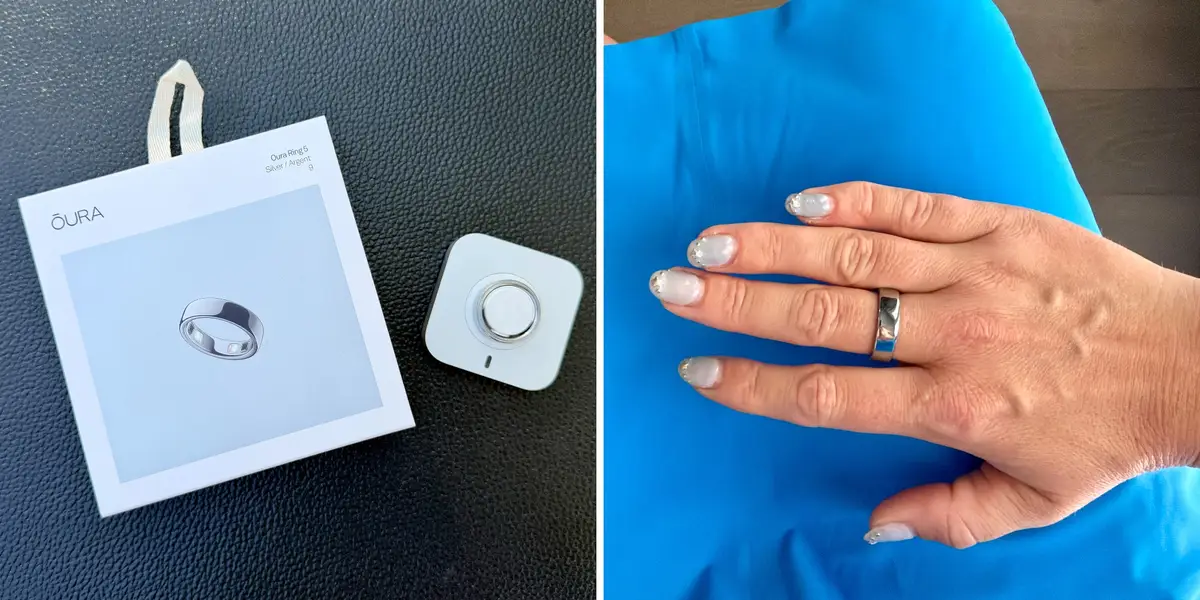
I’ve tested nearly 20 health and fitness trackers over the last two years, and whenever someone asks what wearable they should buy for everyday health monitoring, my answer is almost always the Oura Ring. It’s not suited for fitness coaching or real-time training goals, but it’s ideal for anyone who wants a discreet tracker that quietly supports your well-being by monitoring your sleep, recovery, activity, and overall health in the background.
However, my recommendation always came with one caveat: The ring was a little bulky.
But that downside is no more: In June, Oura launched the Oura Ring 5, a slimmer, lighter ring that’s more comfortable to wear and even more durable and scratch-resistant than its predecessors. After wearing it for four weeks, I can confirm it still offers the best health-tracking and app experience of any smart ring I’ve tested.

The Oura Ring 5 is our favorite smart ring. It tracks your sleep, recovery, activity, and overall health in the background, and this new model is 40% smaller than its predecessor.
What we like
What we don’t like
What’s new with the Oura Ring 5?
The main upgrade in the Oura Ring 5 is the hardware itself. Compared to the Ring 4, the new model is about 40% smaller thanks to a complete redesign of its battery, sensors, electronics, and internal architecture. On your finger, it feels like a different product.
I’ve loved wearing the Oura Ring 4 for the past year, and I’ve certainly gotten used to its slight bulk on my finger, to the point where it didn’t bother me physically unless I was tightly gripping something, like during a deadlift. But, as an aesthetic girl, there were certain occasions when I’d leave it at home. The thicker profile felt a little too obvious for weddings or trips where I knew I’d be taking lots of cute photos. It’s much more subtle than a smartwatch, but it still whispers “wearable” a bit too loudly for me.
The Oura Ring 5 doesn’t even look like a wearable, especially if you already wear a ring stack. Though it’s only 2 cm narrower, it looks much more like a typical ring, to the point that it doesn’t stand out. It’s the same width as a standard male wedding band.
I also found the lighter weight makes it easier to forget about it while sleeping, working, lifting weights, or traveling. Oura becomes more accurate the longer you wear it, so comfort is crucial to getting the most out of the device.
With the size reduction, the Ring 5 has fewer sensors than its predecessor, with 12 signal pathways versus 18 in the Ring 4. (The sensors are what track your biometrics for, ideally, uninterrupted data coming in.) But the Ring 5 is also designed with new low-profile sensor domes, which the brand says provide better contact with your skin and greater accuracy across finger sizes and skin types.
I didn’t see any differences or dips in the consistency of incoming data during my four weeks of testing, and I found the data to be just as reliable as the Ring 4. I also didn’t notice any differences in the health metrics themselves, which makes sense considering the previous generation was already excellent.
Oura says the new sensors improve tracking accuracy, while the titanium construction is even more scratch-resistant than before. After a month of 24/7 wear, my Ring 5 still looks practically brand new and, indeed, is less scratched than my Ring 4 was after the same amount of time.
In addition to the size and sensors, the Oura Ring 5 also offers improved battery life. It’s now rated for an extra day, offering enough battery for up to nine days. Though this upgrade wasn’t necessary, it’s definitely welcome. However, I still wish the ring would vibrate when it’s low on battery, in case you haven’t opened the app to see it’s in its final hours of charge.
Alongside the launch of the Ring 5, Oura also introduced several new software features for all generations, including Health Radar to spot changes in your biometrics, blood pressure alerts, nighttime breathing trends, Health Records that combine clinical history with your wearable data, and AI-powered medical guidance through Counsel AI.
Read more What smart people are saying about Lilian Weng’s departure from Thinking Machines Lab
It’s still the best wearable for understanding your health
I’ve tested nearly 20 fitness and health trackers over the last year, from Garmin running watches to Google’s new faceless Fitbit Air. I consider the Garmin Vivoactive 6 to be the best fitness wearable for tracking workouts, and it’s what I put on whenever I exercise. However, the Oura Ring is the device I choose to wear every day for general health tracking.
That’s because it embraces what Oura calls “quiet technology.” There are no buzzing notifications, incoming texts, or reminders to stand up (though the app can send a “time to stretch your legs” push notification to your phone if you want). The Oura Ring is powered by its sensors and pathways to maintain as continuous a signal as possible for uninterrupted heart rate and skin temperature data. It collects everything while you go about your day, then presents it in one of the most intuitive health apps I’ve used.
Sleep tracking remains where Oura shines brightest. Each morning, the app gives me an easy-to-understand Sleep Score, along with insights into my sleep stages, heart rate, body temperature, and overnight recovery. I’ve also come to rely heavily on the Readiness Score, which combines more than 20 biometric signals to tell you whether your body is primed for a hard workout or would be better served by taking it easy.
I was initially skeptical of relying on a recovery score — don’t I already know when I’m tired and need rest? But after wearing the Ring daily for an extended period, I’ve found it remarkably accurate. More than once, the Ring has flagged elevated body temperature or unusually poor recovery before I realized I was getting sick, convincing me to swap an intense workout for a walk or a rest day before symptoms fully set in.
Women’s health tracking also remains among the best available in any wearable. By combining overnight skin temperature with cycle data and integrations — including Natural Cycles, Clue, and Mira — the app can estimate menstrual phases, predict ovulation windows, and provide increasingly personalized insights.
The Oura app was redesigned last year and remains streamlined, intuitively organized, and easy to navigate. It simplifies complex biometrics into easy-to-understand health insights, and the AI Advisor can answer questions about recovering better, having more energy while menstruating, or improving your sleep (although the newly relaunched Google Health app does this better, in my opinion). Considering a smart ring has no display, the app is arguably half the product you’re buying, and Oura’s holds up to the ring’s price.
But keep in mind that unlocking all of the app’s insights requires a monthly subscription. In addition to the $400 to $500 price of the ring itself (depending on the finish you choose), an Oura membership costs $6 a month. You can get basic metrics — readiness, sleep, and activity — for free, but the majority of the Oura Ring’s features require a subscription, and most people will want those additional insights. In that sense, you should factor in the subscription cost when considering the device.
Who should buy the Oura Ring 5?
If you want the health tracking and insights of a wearable but don’t want either all the pings and notifications of a smartwatch or the visual of an overt wearable, the Oura Ring is definitely the way to go, and the slimmer, lighter design of the Ring 5 makes this the best one to buy.
If you already own the Oura Ring 4, the Ring 5 isn’t an essential upgrade — but if aesthetics are important to you and you regularly take your ring off for nice dinners and photos, it’s probably worth switching. (Worth noting: Oura Rings are HSA/FSA eligible.)
However, the Oura Ring 5 isn’t the right wearable for everyone. If you’re training for a race, want real-time heart rate zones or pace, or want a detailed analysis of your workouts, you’ll be happier with a more fitness-geared tracker like a Garmin, Fitbit, or Apple Watch. Oura will log your workouts and movements and tell you your calorie burn, but it excels most at helping you understand your body between workouts — not coaching you through them.
The bottom line
The Oura Ring 4 was already my favorite smart ring and the health wearable I recommended most often. The Oura Ring 5 doesn’t reinvent that experience — it simply removes the only complaint I had.
It’s slimmer, lighter, more comfortable, and easier to wear every hour of every day, which ultimately makes it better at doing what it’s designed to do: quietly building a complete picture of your health in the background. Though you can still find the older Oura Ring 4 discounted, the new Ring 5 is the version I recommend the most.
About the Author