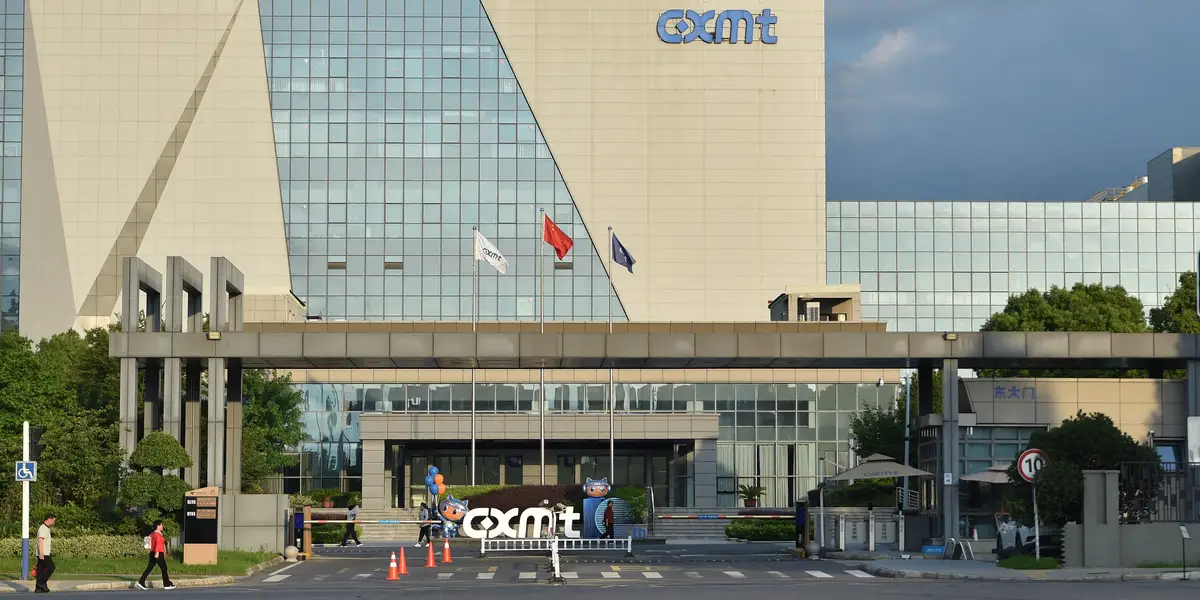
China’s largest semiconductor IPO on record instantly produced the mainland market’s most valuable listed company, highlighting investors’ enthusiasm for Beijing’s AI ambitions.
Read more Sam Altman says we are in the singularity: ‘This is the moment’
Shares of CXMT Corp., China’s largest maker of DRAM memory chips, surged over 500% in under two hours of trade in their debut in Shanghai on Monday.
The company previously known as ChangXin Memory Technologies raised 57.92 billion Chinese yuan, or about $8.6 billion, with proceeds potentially rising to 66.6 billion yuan if an overallotment option is fully exercised. It was China’s second-largest mainland IPO on record, behind Agricultural Bank of China’s 2010 offering.
At the opening price of 49.50 yuan — compared with an IPO price of 8.66 yuan — CXMT was valued at about 3.3 trillion yuan, or roughly $487 billion.
That made it the most valuable company listed on China’s mainland market, overtaking Industrial and Commercial Bank of China.
CXMT’s blockbuster listing reflects strong demand for Chinese chip stocks as investors bet that domestic manufacturers will benefit from Beijing’s effort to reduce the country’s reliance on foreign technology amid US export restrictions.
Demand for the offering was exceptionally strong, with the retail portion 212 times oversubscribed.
As the world’s fourth-largest producer of DRAM chips — behind Samsung Electronics, SK Hynix, and Micron Technology — CXMT’s stock price could have much further to go.
Nomura initiated coverage on Monday with a Buy rating and a 116 yuan price target, based on its 2028 earnings estimates.
“The global supply of memory is unlikely to ease in the coming years,” analysts at Nomura wrote.
The bank expects CXMT’s share of global DRAM production to rise from about 10% currently to roughly 18% by the end of 2028.
However, there are risks, including weaker customer demand, greater domestic competition, and component shortages.
“Rising geopolitical tensions between the US and China, which would put CXMT’s business development, capacity expansion, and technology migration at risk,” Nomura’s analysts wrote.
It also identified weaker customer demand, greater domestic competition, and component shortages as risks.
Read more Don’t like AI? Linux’s creator says go fork yourself
About the Author